What is the main difference between the two games?
Wordle is a guessing game with exactly one answer: you have six attempts to identify a hidden five-letter word, and each guess is graded with coloured tiles. Squaredle.fun is a word-search game without a single answer: you trace connected letters on a 4×4 or 3×3 board, every recognised word scores points, and a round ends when you stop rather than when you guess wrong.
That difference drives everything else in this Squaredle vs Wordle comparison. One answer makes Wordle short, sharp, and easy to compare with other players. Many words make this site longer, more exploratory, and harder to finish in one sitting. Both are legitimate daily habits; they reward different things.
How Wordle is played
Wordle is a daily five-letter guessing game published by The New York Times. Each puzzle hides one five-letter answer. You type a guess and the game marks every letter: green for the right letter in the right place, yellow for a letter that belongs elsewhere in the word, and grey for a letter the answer does not contain. Six guesses are allowed per puzzle, and every player receives the same answer on the same date.
The loop is pure deduction. Each guess narrows the letter set, and the remaining attempts are spent placing letters you already know belong in the word. The official game offers no letter hints beyond that colour feedback, keeps one new puzzle per day in the standard free game, and does not keep a score: the result is simply how many guesses you needed. A puzzle ends either when the answer is found or when the sixth guess is used up.
How Squaredle.fun is played
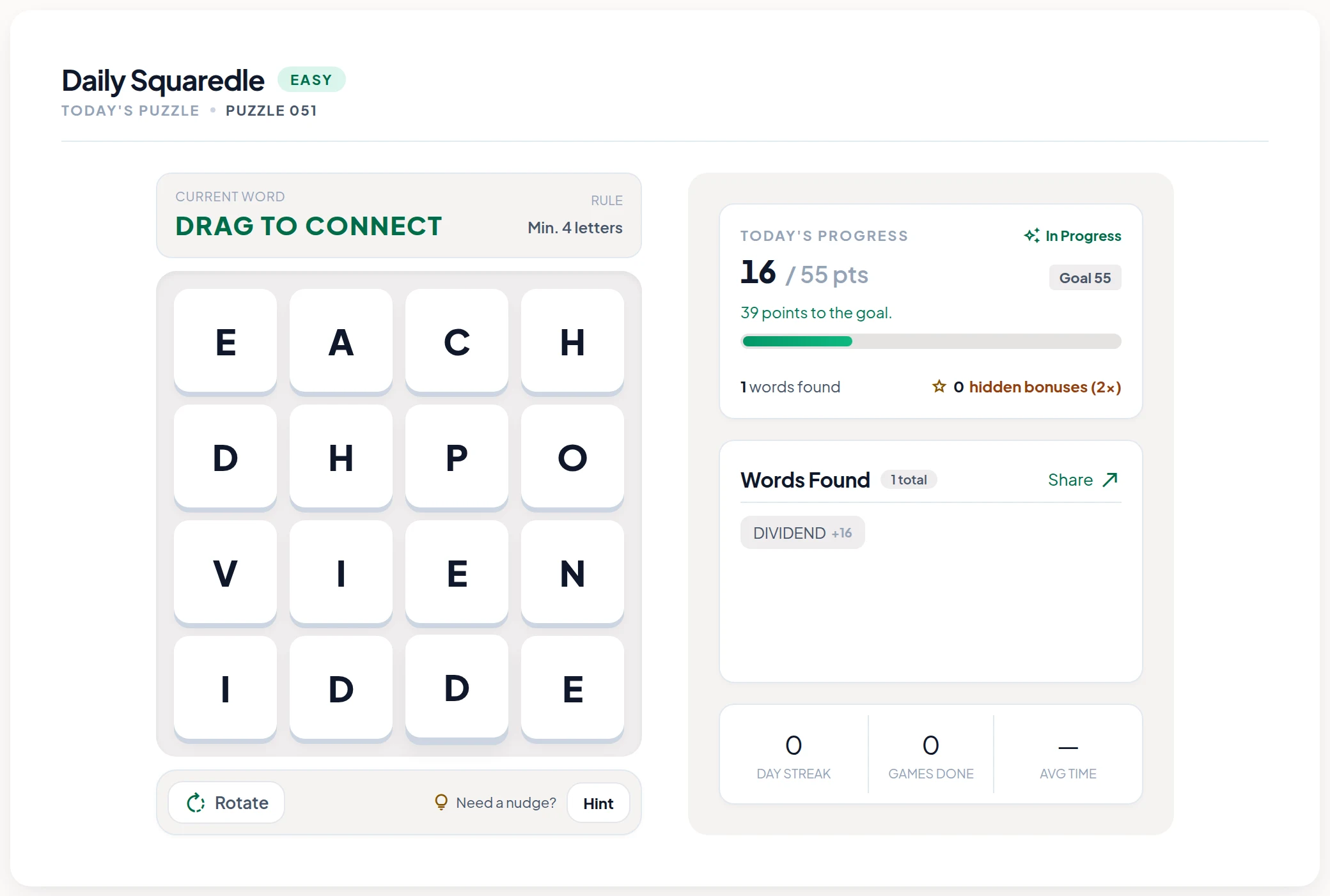
This site is a word-search game on a square board. You press a starting tile, drag through touching letters in any of the eight directions, and release to submit a word of at least four letters. A tile cannot be used twice inside one word, but it can be reused for a different word. Every recognised word earns points based on its length, hidden Bonus words earn double, and the challenge is complete when the score reaches the board's published goal.
There is no attempt limit and no failure state: a rejected word simply does not score, so a board can be left and resumed later from saved progress. After the goal is reached the board stays playable and the score keeps rising. A Hint button reveals the first two letters of a word that is a common word still waiting to be found and briefly traces its opening path. The full rule set, including accepted spellings and scoring values, is on the how-to-play page.
Squaredle vs Wordle at a glance
The table compares the two games on the things that change how a round feels: what you are trying to produce, how many attempts you get, what happens when you fail, and how much there is to find on a single board.
| Feature | Squaredle.fun | Wordle |
|---|---|---|
| Daily puzzle | One shared 4×4 board per date, rolling over at 3am Pacific Time. | One hidden five-letter answer per date. |
| What you do | Trace touching letters in eight directions to spell words of four letters or more. | Type five-letter guesses and read the colour feedback. |
| Words in a puzzle | 105 to 600 accepted words per 4×4 board in the current pool, with a median of 216. | One answer; guesses are attempts, not discovered words. |
| Attempts | No limit. Rejected words do not score and are not penalised. | Six guesses, then the day's puzzle is finished. |
| Goal | Reach the board's published score goal. | Identify the answer within six guesses. |
| Failure state | None. Progress is saved and can be resumed. | The round is lost if the answer is missing after six guesses. |
| Scoring | Points by word length, double for hidden Bonus words, shown on a goal meter. | No score; the outcome is how few guesses were needed. |
| Built-in help | A hint reveals the first two letters of an unfound common word and traces its opening path. | Colour feedback from earlier guesses only. |
| Other modes | Daily, Unlimited, Express 3×3, and a Weekly challenge. | One new puzzle per day in the free game. |
| Saved progress | Saved in the browser, separately for each mode. | Results and statistics are stored in the browser. |
Scroll sideways to read every column
Where Squaredle has the advantage
This site rewards breadth instead of a single insight. A 4×4 board holds far more accepted words than most players will find in one sitting, so the round scales with how long you want to play, and nothing can end it early.
Many words per board, not one answer
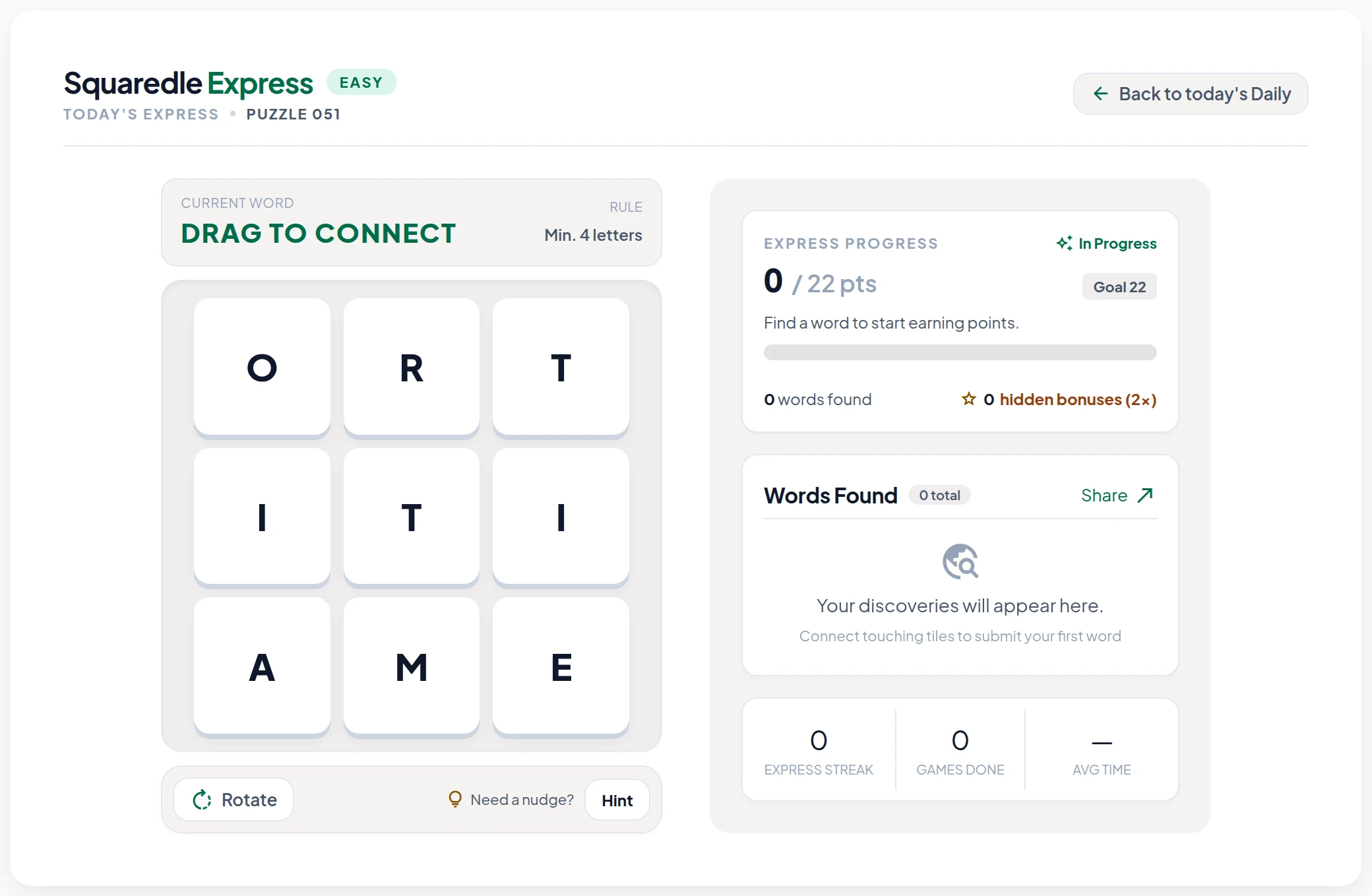
In the current published pool, every 4×4 board accepts at least 105 words and the median board accepts 216. The 3×3 Express boards run from 23 to 149 words, with a median of 54. That spread is why a session can be three minutes or thirty: the board has not run out, you have simply stopped looking.
No loss state and no dead ends
A wrong guess costs nothing here. There is no sixth attempt that ends the day, no penalty for trying an unusual spelling, and no need to decide whether to risk a guess. You can exploit that freedom by testing letter clusters you are unsure about, which is a far more relaxed way to learn new words than a six-guess timer.
A goal you can pass and keep playing
Reaching the score goal completes the challenge, but the board stays open and points keep accumulating. Players who want a stopping point have one; players who want to keep hunting are not cut off. Progress is saved per mode, so a long board can be picked up on the next visit.
Hidden Bonus words reward curiosity
Less common words are accepted and marked as hidden Bonus finds worth double points, revealed only when you discover them. The mechanic turns an unusual-but-valid word into a small reward instead of a rejection, which keeps the vocabulary ceiling high without making common words feel useless.
Four modes and a solver
The same rules power four different sessions: the shared Daily 4×4 board, replayable Unlimited boards, shorter Express 3×3 rounds, and the harder Weekly challenge. A board solver is available for studying a grid or checking paths afterwards.
Where Wordle still has the advantage
Wordle is not the weaker design, it is the smaller one. It fits in two minutes, needs no explanation, and hands every player the same single answer, which is exactly why it became a shared daily ritual.
- Session length. A round ends in a few minutes, so it fits a commute or a coffee break with room to spare.
- One answer to discuss. Shared guess counts and the emoji grid let players compare results without spoiling the word.
- Instant to learn. The rules fit in a sentence, which makes it easy to recommend to a parent, a child, or a colleague in the same breath.
- Deduction over vocabulary. A small letter set keeps early guesses productive even when the answer turns out to be an unfamiliar word.
Our review scorecard
The scorecard rates both games on the qualities a daily word player usually cares about, out of five points each. These ratings are editorial judgement about how the two games feel to play every day, not a measured benchmark. Wordle's rules and options are described from its public gameplay at the time of review; its publisher can change them.
| Category | Squaredle.fun | Wordle |
|---|---|---|
| Rules to learn | 4 / 5 — four letters minimum, eight directions, no tile reuse in a word. | 5 / 5 — one sentence covers the whole game. |
| A quick round | 3 / 5 — a full board rewards a longer sitting. | 5 / 5 — usually finished in two or three minutes. |
| Depth in one session | 5 / 5 — dozens of words are still waiting when you stop. | 3 / 5 — one answer, then the day is done. |
| Replay value | 5 / 5 — four modes, plus a solver for studying boards. | 2 / 5 — one fresh puzzle per day in the free game. |
| Built-in help | 4 / 5 — two-letter hints, but no full reveal of a word. | 2 / 5 — only the colour feedback from earlier guesses. |
| Progress saving | 4 / 5 — local save for each mode, no account required. | 4 / 5 — statistics kept in the browser. |
| Accessibility | 4 / 5 — keyboard path selection, screen-reader labels, reduced-motion support. | 4 / 5 — keyboard-first entry, but colour is the only in-game signal. |
| Cost | 5 / 5 — free, with no account. | 5 / 5 — the daily puzzle is free, with no account. |
Squaredle.fun 34 / 40 · Wordle 30 / 40
Wordle wins the categories about speed and simplicity, and it deserves them. This site wins the categories about depth, replay, and help, which is what its board size and scoring are built for. Neither result is an accident of the table: they reflect two different designs of the same daily habit.
Which word game should you play?
Choose Wordle if you want one small puzzle a day, a clear right answer, and a result you can trade with friends in an emoji grid. Choose Squaredle.fun if you would rather keep hunting after the first minute, dislike losing a round to a guess, or want a game that grows with your vocabulary.
- Playing with family or colleagues. Wordle's single answer makes conversation easy; here, compare scores and word counts instead.
- Learning new words. This site accepts broad English spellings and rewards uncommon finds, so experimentation is part of the game.
- Wanting a longer session. Continue into Unlimited or drop to the shorter 3×3 Express rounds for a middle ground.
- Stuck on a board. Use the solver to study paths, or read the rules and tips first.
Squaredle vs. Wordle: quick answers
These are the questions readers ask most often when choosing between the two games. Each answer applies to this site's own rules unless it names Wordle explicitly.
Is Squaredle the same as Wordle?
No. Wordle is a five-letter guessing game published by The New York Times, with one hidden answer per day. Squaredle.fun is an independent word-search game where you trace touching letters to find many words on a board. The names sound alike, but the rules and the skills they test are different.
Does Squaredle limit how many words I can enter?
No. Every recognised word on a legal connected path is accepted, and a board keeps taking words after the score goal is reached. Rejected words do not count against you; they simply do not score.
Can I lose a Squaredle round?
There is no loss state. A board cannot run out of attempts, so you can leave it, come back later, and keep going from your saved progress. Wordle, by contrast, ends the day’s puzzle after six guesses.
Is Squaredle harder than Wordle?
It is longer rather than harder. Both ask you to spot English words, but Wordle tests deduction against one answer inside six guesses, while this site tests breadth of vocabulary across a whole board. A slow start also matters less here: a rejected word is not a lost round, whereas Wordle can run out of guesses.
Which game is better for comparing results with friends?
Wordle is easier to discuss because everyone shares one answer and the guess count. Scores here can be compared instead: the goal meter, total score, and the number of words or Bonus words found all give a shared reference point.
Do I need an account for either game?
No account is needed here, and none is needed for the standard Wordle daily puzzle. This site saves your progress and streak locally in your browser rather than on a server.